Feature Guide · Condition
The useful photograph is the one
taken before parking.
Condition capture is a sequence, not a camera feature: observe the vehicle at intake, attach the observation to the session, and preserve who added what afterward.
What it is
A session-level walk-around with photos, locations, notes, and history.
Valletto records vehicle condition against the visit that is about to take place. An operator can require that inspection before the car moves from received into parking.
That timing gives a later reviewer useful context. It does not turn the software into an appraiser, an insurer, or a court.
Who uses it
Condition capture serves the curb first and the later review second.
Valet
Records the vehicle before parking
The intake can require an inspection before the session moves from received into parking, according to location settings.
Manager
Reviews the session history
A manager can open the session, see the vehicle images and damage entries, and understand who added each observation and when.
The setup order
The location decides whether inspection gates parking; the session carries the result.
1 · Policy
Choose whether condition is required
A location setting can block the move into parking until the valet records damage or confirms the car is fine.
2 · Capture
Photograph the current vehicle
The camera produces a session image sized for operational use; the capture belongs to this visit, not a generic vehicle profile.
3 · Describe
Place a pin, choose a kind, add a note
Observed damage can carry a vehicle-relative point, category, photo, note, creator, and timestamp.
The daily loop
The discipline is about sequence: observe before custody changes.
Walk around
Capture before the car is parked
The valet inspects the car while it is still at the intake point, when the current condition can be associated with the handoff.
Resolve
Damage recorded or car marked clear
A required inspection has an explicit completion state; simply opening the camera is not the same as completing it.
Carry forward
The board and record show condition context
A damage banner and the session detail view make the observation available without turning it into the card's primary action.
The edge cases
Later information is additive so the original walk-around is not silently replaced.
Later observation
New entries join the history
A team member can add another observation later. Creator and time distinguish it from what was recorded at intake.
Image unavailable
A failed upload is not a completed inspection
The interface keeps the user in the capture flow or reports the failure rather than producing an empty proof artifact.
Guest view
Access is scoped to the guest session experience
The condition record is not published as a public gallery; guest-facing access follows the session's controlled link surfaces.
What it deliberately does not do
A contemporaneous operational record is useful precisely because its claim is narrow.
Not an appraisal
Valletto does not value or repair damage
The record captures observations. It does not estimate cost, assign fault, or diagnose what caused a mark.
Not a legal guarantee
A photo is context, not a promised outcome
The product does not claim evidentiary admissibility or that an image will settle a claim by itself.
What it connects to
Condition belongs with the ticket, not in a separate claims folder.
Guided Check-In
The current visit's capture
The intake hands its fresh vehicle image into the session being created.
Session record
Searchable history
Photos, pins, notes, authors, and timestamps remain with the same operational record.
Dispute record
Context assembled later
When a payment is disputed, session and vehicle evidence can be assembled into the record without recreating the night from memory.
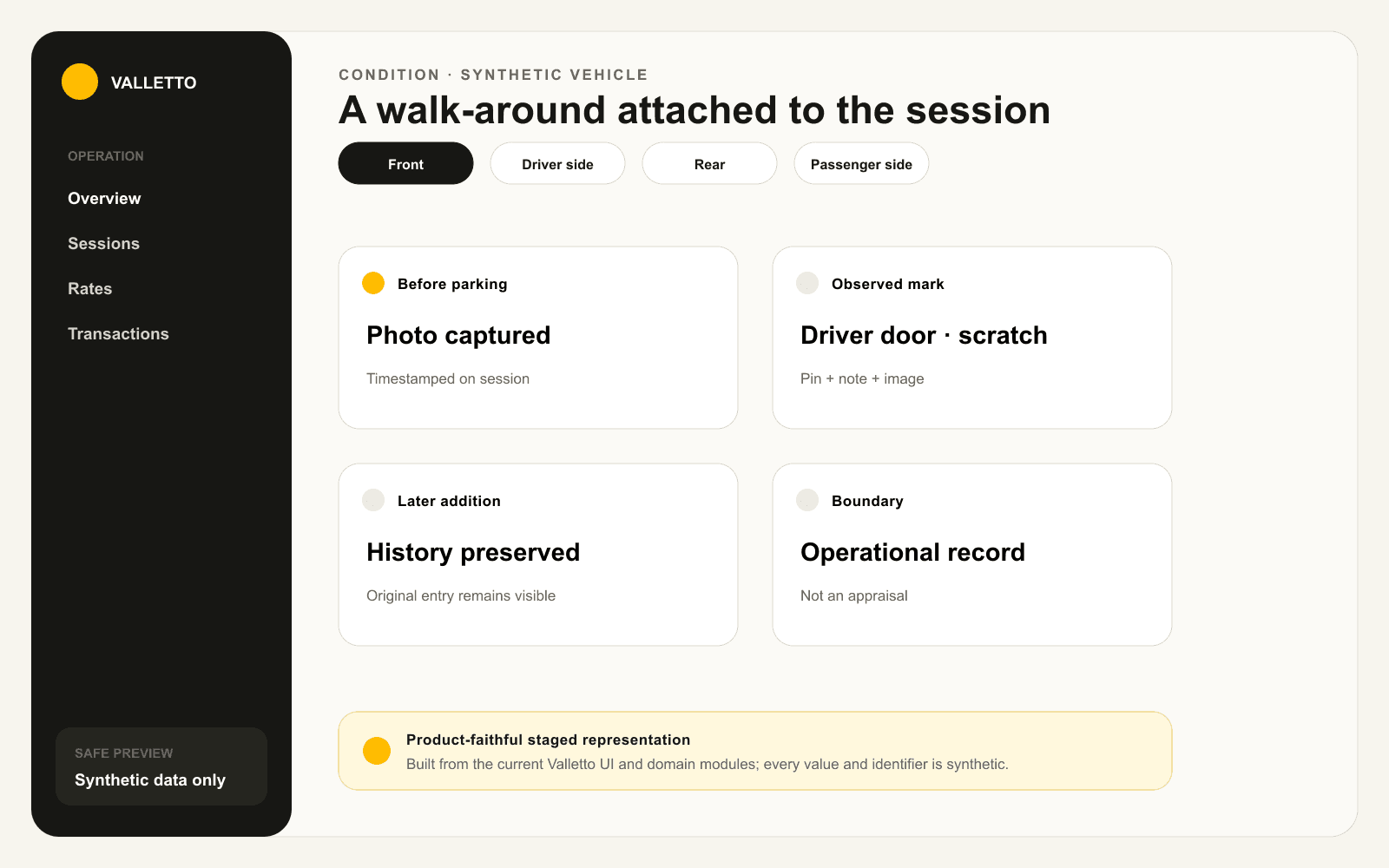
→Staged from the current iOS and Android damage modules. It contains no real car, plate, person, place, or claim.
The practical result
The record remembers the walk-around so a person does not have to reconstruct it later.
Useful condition evidence is attached early, stays attributable, and remains only as strong as the observation it contains.
Next: open the full session record that condition becomes part of.
