Feature Guide · Disputes
The useful dispute record was built
before the dispute.
A chargeback response is strongest when the visit, payment, messages, and vehicle context were already recorded - and weakest when software promises an outcome it does not control.
What it is
A generated record of available session and payment evidence.
When a dispute arrives, Valletto can assemble the facts already attached to the charge and its visit into a reviewable report. The workflow reduces memory work; it cannot create facts the operation never captured.
Visa Compelling Evidence 3.0 has narrow qualification rules, and neither eligibility nor submission guarantees the final decision.
Who uses it
The owner needs a ready record; the issuer still decides the dispute.
Owner
Reviews what was assembled
The report organizes payment, session, vehicle, communication, and timeline material that already exists.
Payments team
Responds through the processor
Processor deadlines, eligibility, evidence fields, and submission status remain authoritative.
The setup order
Useful evidence is captured during the visit, before anybody knows a dispute will exist.
1 · Session
Record the car, stand, ticket, times, and actors
Normal check-in and status work creates the operational timeline.
2 · Payment
Keep the transaction and receipt context
Amount, method, processor identifiers, modifiers, and status stay linked to the session.
3 · Dispute
Assemble the record when the processor notifies Valletto
The dispute workflow collects available evidence and renders a report; absent facts remain absent.
The daily loop
The goal is retrieval, not recollection.
Collect
Review the visit
Your team can review the available visit details without rebuilding the night from memory.
Present
Organize summary, timeline, vehicle, and communications
The report contains private visit information and should only be shared with the people handling the dispute.
Respond
Use the processor's dispute workflow
A human reviews the record and any required fields before submission.
The edge cases
Eligibility is narrower than the phrase compelling evidence suggests.
Missing facts
The report does not invent them
No photo, message, prior payment, or guest identifier is fabricated to fill an evidence slot.
Visa CE 3.0
Specific 10.4 card-absent disputes only
Stripe documents qualifying Visa reason-code 10.4 disputes, two prior undisputed transactions in the required window, and matching evidence elements.
Other disputes
Standard evidence still matters
A report can remain useful even when CE 3.0 is unavailable; the processor's ordinary evidence path and deadlines apply.
What it deliberately does not do
A record can improve preparation without guaranteeing a win.
No outcome promise
The issuer and network decide
Valletto does not decide, reverse, or guarantee a dispute result.
No universal CE 3.0 claim
Qualification is processor- and transaction-specific
Stripe notes that qualified enhanced evidence status is distinct from the dispute's won or lost status.
What it connects to
The report supports your team’s review of a disputed visit.
Official scope
Visa and Stripe define CE 3.0
Visa: https://usa.visa.com/content/dam/VCOM/regional/na/us/support-legal/documents/compelling-evidence-3.0-merchant-readiness-mar2023.pdf
Processor implementation
Stripe's current eligibility guide
https://docs.stripe.com/disputes/api/visa-ce3
Session and transaction
The operational and payment sources
The finished visit, its condition, messages, and charge are the durable inputs the report can actually support.
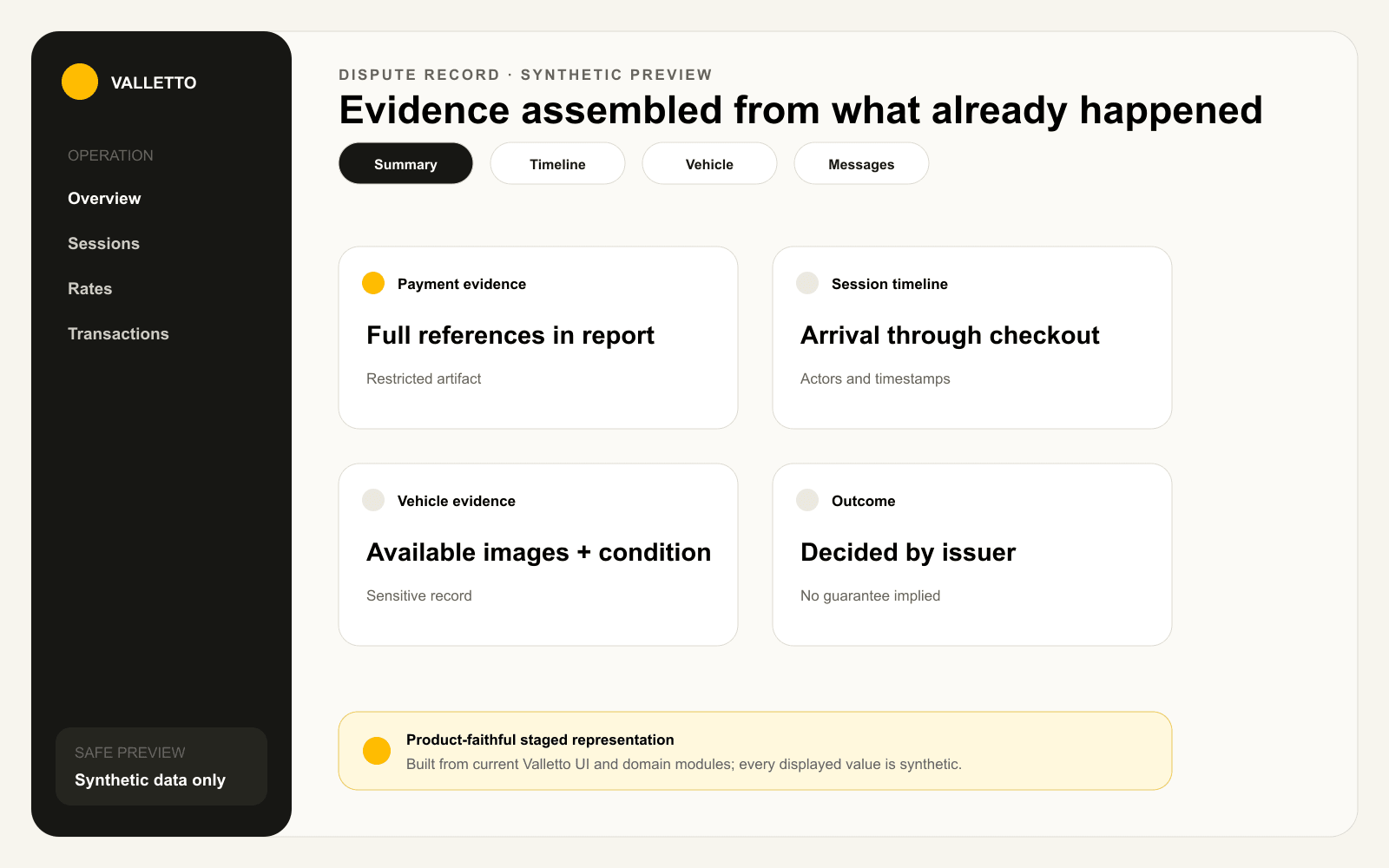
→Illustrative dispute report. No real charge, guest, vehicle, or dispute data is present.
Where Valletto changes the math
Preparation can be automatic. Outcomes cannot be promised.
The product's job is to preserve and assemble the visit honestly, then leave qualification and decision to the payment network.
Next: see how the same audience-first discipline keeps notifications useful.
