Feature Guide · Team
Several races,
several winners
A leaderboard sounds like a bad idea for a team - one winner, everyone else ranked below them. Valletto's doesn't work that way. It asks six better questions instead of one bad one, and it's built so a reliable person can top a board a fast person never will.
Why the shape matters
'Who's the best valet' is the wrong question. It only has one right answer.
Rank a team by job title, or by one all-purpose score, and you get exactly one winner and N-1 people who lost. That's not a leaderboard - it's a verdict. Early versions of this screen worked exactly that way: one board, split by role. Valets against valets, supervisors against supervisors. It asked who the best valet was, and every reader who wasn't at the top learned the same thing about themselves, week after week.
The fix wasn't a better formula. It was better questions. Instead of one ranking by role, the board asks who moves the most cars, who turns up on time, who scans plates, who walks the car at check-in, and who picks up shifts - grouped into a handful of boards a person would actually want to be, not metrics they'd be embarrassed to place third in. Same roster, several races, and a person who will never top the fastest board can still be first at showing up. That's not a consolation prize. Reliability is the thing most operators are actually short on.
This is built for two people at once. An operations manager sets up recognition without agonizing over who to call out - the board already picks several worthy names a week, on its own. And it's built for the owner who hears “leaderboard” and immediately worries about the people who don't come out on top. The direct answer is the structure itself: with several boards running at once, the question stops being “who's losing” and becomes “which race is this person winning,” because for most of a team, there's a real answer.
What it is
One scoring system, several boards, and no board asks about your title
Four boards: All, plus three things worth being
Every valet lands on every board. There's no board you have to be a certain role to appear on, and no board you're excluded from.
Default, first
All
The overall picture: every award added up against the hours worked. It's not a fourth ranking layered on top - it's the same ungrouped weekly score the other three boards are built from, shown first because a reader wants the whole picture before picking a race to look at.
Board 1
Team player
You make the shift work for everyone else - the credited acts that keep a garage running as a unit, not just your own throughput.
Board 2
Attention to detail
You do it properly the first time, so it holds up later - plate scans, condition notes, the parts of a check-in that protect the car and the company.
Board 3
Hustle
You move, and guests don't wait - car legs, retrieval speed, the visible tempo of a shift.
→Every board is scored in the same unit - points earned per hour worked - so a person's standing on any one of them is directly comparable to their standing on the others, and they all roll up into the same overall number on “All.”
There's no board by role, on purpose
A role filter survived one earlier revision of this screen as an optional toggle. It was removed - deliberately, not by oversight.
A board per role
What it was- Ranks a person against their job title
- One winner per role, everyone else below them
- A manager near the top of a valet board reads as unfair - because the comparison itself is unfair
A board per task
What it is now- Ranks a person against the work they actually did
- A manager won't appear near the top of Hustle - they aren't moving cars, so the category sorts it out on its own
- A manager topping Team player is genuinely interesting, not a fairness problem to filter away
→The task categories dissolve the fairness question by themselves. Once you're ranked on what you did rather than who you are, a role filter has nothing left to protect anyone from.
Where a score comes from
Nothing on this screen invents a number. There is exactly one scoring system for the whole product, and exactly one thing that ranks anybody on it.
A shared catalog of credited actions - checking a car in, scanning the plate, finishing a shift, and the rest - carries a point value per action. A scheduled job totals those points for the week, divides by the hours a person honestly worked, and writes the resulting rate back to their record for every board at once. The screen you see is a read of that stored result: it orders rows by the rank the job already computed, and it never recalculates a position on its own. There's no separate live feed and no re-scoring as you watch - the board states plainly how fresh it is (typically refreshed every several minutes) rather than pretending to be live.
Two protections come from that same job, not from the screen: someone who just joined the team is shown but deliberately left unranked for their first several weeks - a first month is never a public verdict - and anyone who worked too few hours that week is also shown, not ranked, because a short week produces a flattering rate rather than a fair one. A board with too few ranked people to mean anything lists everyone without positions instead of crowning someone “1st of 1,” which reads as mockery on the one screen that must never mock anybody.
Tapping a name opens one drawer, one level deep
It reports what someone did. It never reports what they failed to do.
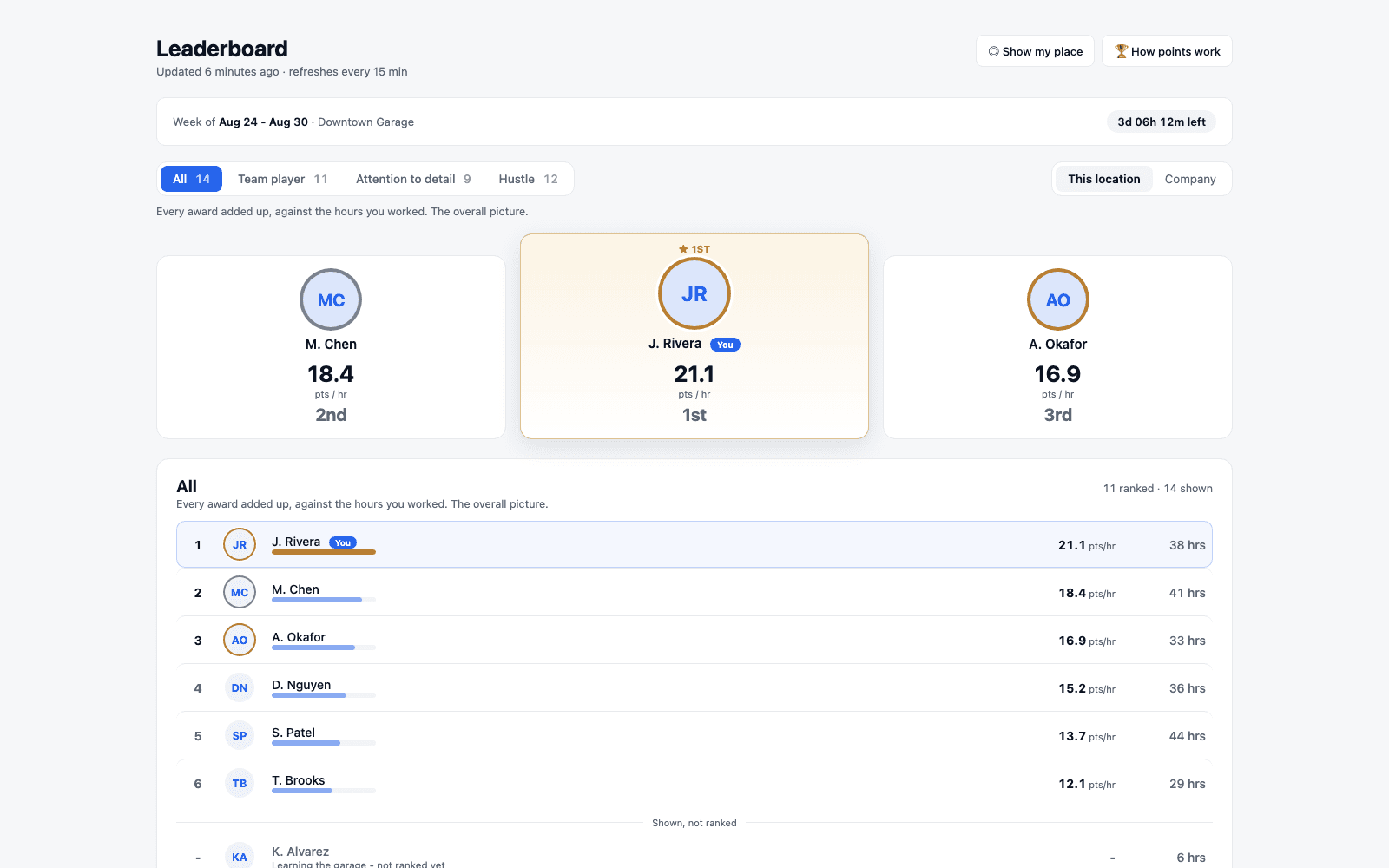
→“All” leads and is the default tab. Tabs for Team player, Attention to detail, and Hustle sit beside it - there is no tab for role.
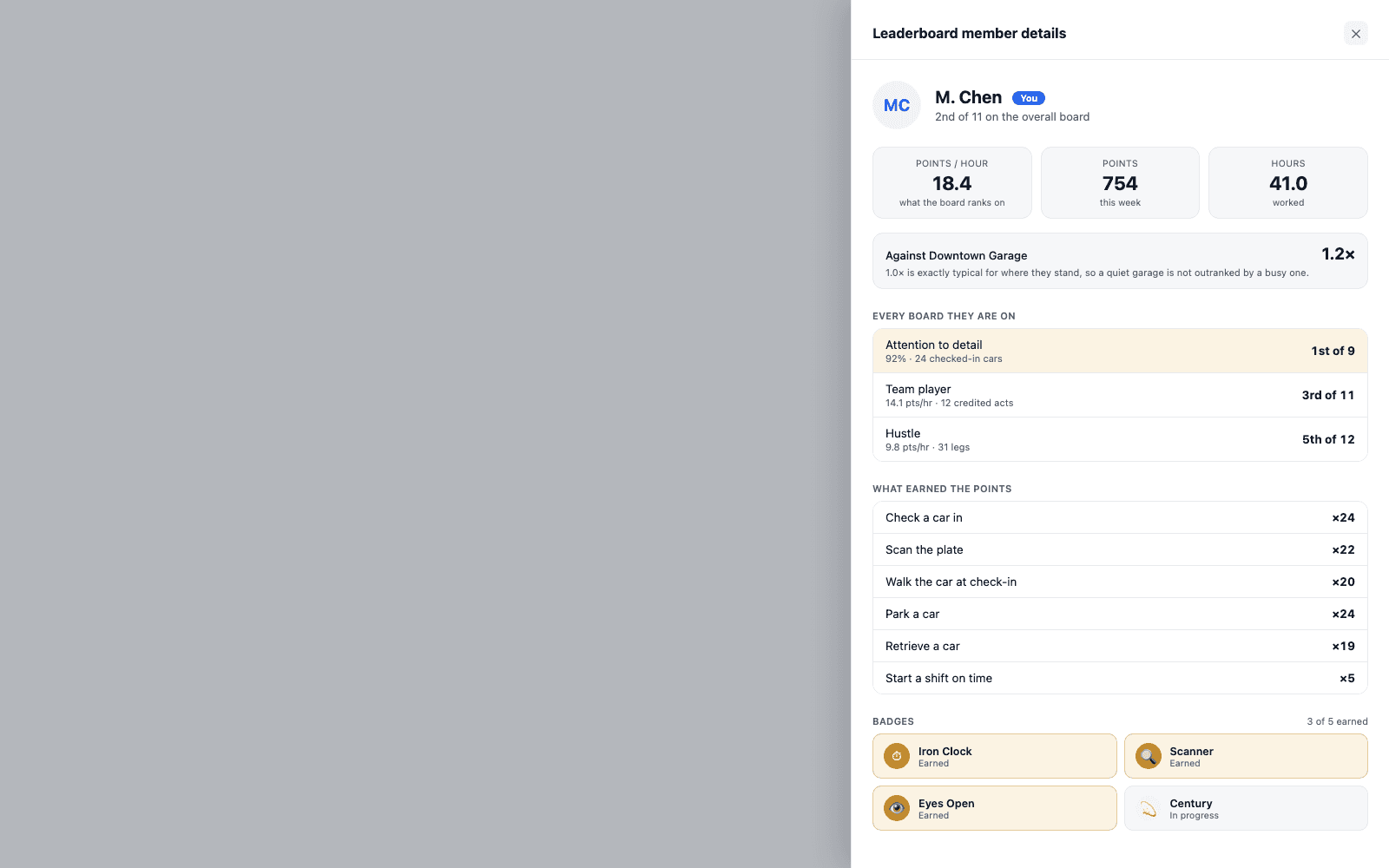
→Every race this person is in shows up in one list, so someone who's ninth at moving cars can see, on the same screen, that they're first at attention to detail.
The drawer opens to a header with the person's name and their standing on whichever board was open when you tapped them. Below that: three stat tiles for points per hour, total points, and hours worked this week; when you're comparing across a whole company, a note on how that person's rate compares to their own location's typical rate, so a quiet garage doesn't get outranked by a busy one on a shared board. Then a list of every task board that person appears on, a breakdown of which credited actions earned their points, and their badges. What's missing is deliberate: no no-show count, no late count, no red anywhere. This is not the evidence pack for a disciplinary conversation, and it was built so it can't become one by accident.
Seeing your own standing
The board doesn't just show you where everyone stands - it tells you, in one line, where you stand and where you're winning.
A “Show my place” button scrolls straight to your own row, which is visually highlighted everywhere it appears - the podium, the ranked list, the drawer. Below the board, a standing line states plainly which boards you currently lead (task boards only, since leading the overall board is already the headline stated above it), followed by your position on whichever board is open. If you're shown but not ranked, it says exactly why - new to the garage, or under the hours floor this week - rather than leaving you to guess. And if you're not on the current board at all, it tells you how many other races are running and points you at them instead of just going quiet.
How it actually gets used, week to week
There's no reason to check this daily - it settles for the week and states plainly when it last refreshed.
In practice, the board gets opened a handful of times a week, not constantly: a valet checking it after a shift to see whether they moved up a board, an operations manager glancing at it before a team meeting to see who's worth calling out by name, an owner scrolling to the bottom for the plain-English standing line instead of doing the reading themselves. Nobody needs to explain how the points work to use it - the “How points work” button on the header spells out the award catalog for anyone who wants the detail, but the board itself reads fine without it: a name, a rank, a rate, and how many hours it was earned over.
What it deliberately does not do
The list of restraint is as deliberate as the list of features
No role ranking, no live re-scoring, no negative behavior
Every one of these was cut on purpose, and each one has a reason worth knowing before a skeptical owner asks about it.
Not there
A ranking by role
Removed, not forgotten. Valets, supervisors, and managers all sit on the same task boards, ranked on the same work.
Not there
Live, real-time re-scoring
One scheduled job ranks everyone, on a fixed refresh cycle the screen states out loud. There is no second scoring path anywhere on this screen.
Not there
Negative counts
No no-shows, no lateness, no 'last place' styling, and no badge for anything you failed to do. This screen only reports what happened, never what didn't.
Not there
A time-range switch
The board only stores one week at a time, so there's no daily, monthly, or seasonal toggle pretending to answer a question the data can't actually answer.
Not there
Money, anywhere
Points and hours only. Pay, tips, and payroll live in their own part of the product, not next to a ranking.
→The rule underneath all of it: nothing on this screen may say something about a person that isn't backed by what they actually did.
What it connects to
The leaderboard reads the same score other parts of the product already show - it doesn't compute a second opinion of anyone.
The points and hours behind every board come from the same underlying activity that feeds Team and payroll: shifts worked, cars checked in and retrieved, plates scanned. Badges pull from the same credited-action catalog the drawer breaks down. None of it changes how pay is calculated, and none of it feeds back into role or permissions - a person's standing on the leaderboard has no effect on what they're allowed to do elsewhere in the product. It's a read-only reflection of a week of work, built to be shown to the whole team without anyone needing to explain a formula.
Where Valletto changes the math
Recognition that doesn't require picking a favorite.
An operator worried a leaderboard will be divisive is worried about the wrong shape of leaderboard - one winner, one race. This one runs several races at once, on the same roster, scored the same honest way every time.
The takeaway: rank people by task instead of title, and you stop asking one unfair question and start asking six fair ones. If you're setting up recognition for a team that already runs on Valletto, start here - then look at how Badges layer on top of the same underlying activity to reward personal-best streaks that never depend on hours worked.
